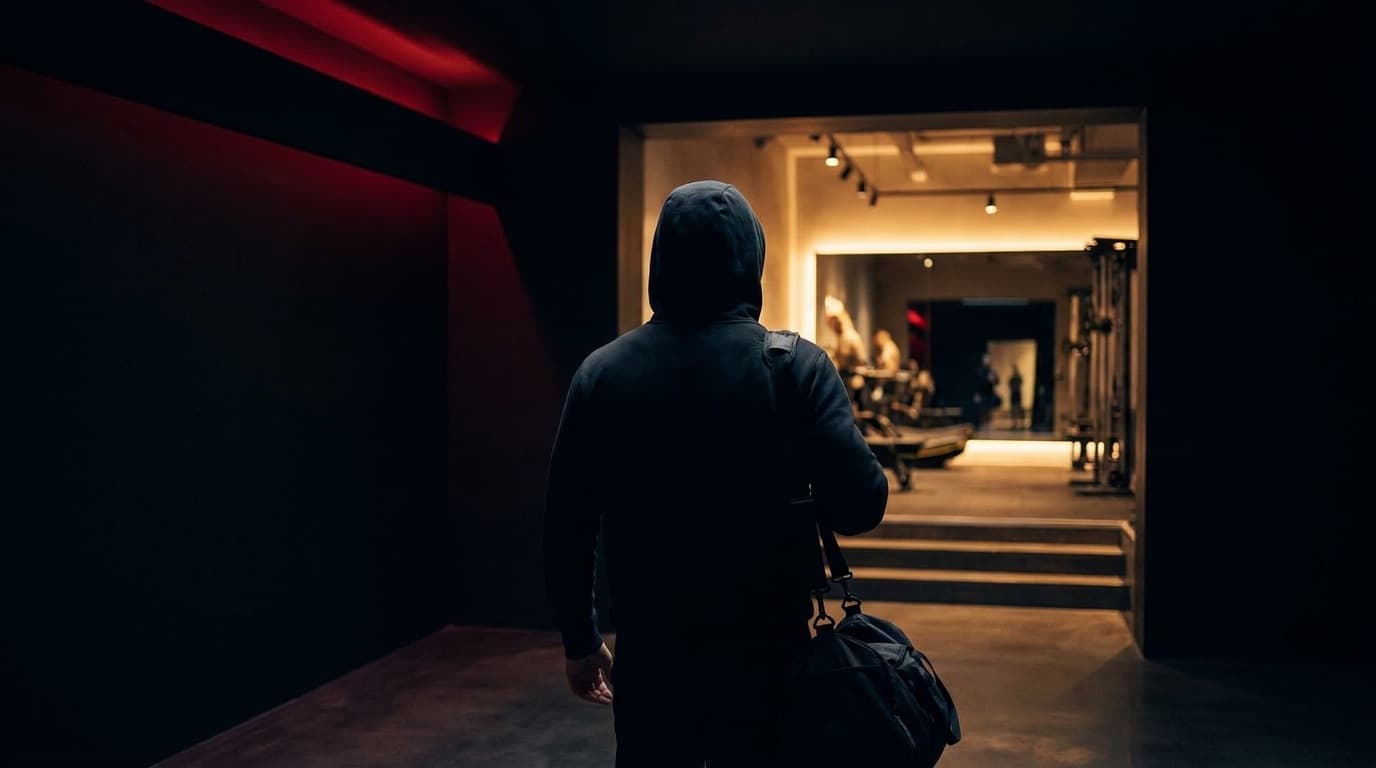
I've trained national-level competitors, and I've trained people who sat in the parking lot for 20 minutes too scared to walk through the door. Here's something the second group never believes at first: gym anxiety is one of the most common things I see, and it's also one of the most beatable. After 18 years, I can tell you exactly how to walk in confident.
Key takeaways:
- Gym anxiety is normal — most beginners feel it, and most experienced lifters once did too.
- The "everyone's watching you" feeling is the spotlight effect — they're not, they're focused on themselves.
- Walking in with a written plan removes 90% of the anxiety.
- Start at off-peak hours and grow from there.
- A coach removes the guesswork entirely — see how I work.
Why does the gym make me so anxious?
Gym anxiety usually comes from three things: feeling judged ("everyone can tell I'm new"), not knowing what to do (which machine, how many sets), and comparing yourself to people who've trained for years. All three are normal, and all three shrink fast once you understand them. The single biggest one — feeling watched — is largely an illusion psychologists call the spotlight effect.
It feels intensely real. It's also almost entirely in your head, and I mean that kindly. Let me explain why.
Is everyone actually watching me?
No. What you're feeling is the spotlight effect — our tendency to massively overestimate how much others notice us. In reality, the people at the gym are focused on their own workout, their own form, their own playlist. The experienced lifters you're intimidated by? They respect anyone who shows up to better themselves — every one of them was a nervous beginner once.
I've spent my entire adult life in gyms. I promise you: nobody is keeping score of the new person on the lat pulldown. They're thinking about their next set.
How do I walk in feeling confident?
Confidence at the gym comes from having a plan, not from waiting to "feel ready." When you walk in knowing exactly what you're going to do, the anxiety has nowhere to live. Here's the system I give nervous beginners:
- Bring a written plan — your exact exercises, sets, and reps, on your phone. No on-the-spot decisions.
- Go at off-peak hours first — mid-morning or early afternoon, when it's quiet.
- Master a few machines before touching the busy free-weight area. Machines guide the movement and feel safer.
- Wear headphones — they create a personal bubble and signal "I'm focused."
- Start with a short, winnable session — 30–40 minutes. Finishing builds the confidence for next time.
You don't wait until you're confident to start. You start, and the confidence shows up a few sessions in.
A beginner-friendly first workout
Keep your first week stupidly simple. A short full-body session on machines removes almost every source of anxiety — guided movement, easy to learn, no balancing barbells in front of people:
| Exercise | Sets × Reps | Why | | --- | --- | --- | | Leg press | 3 × 10 | Big muscles, guided path | | Chest press machine | 3 × 10 | Easier than free-weight bench | | Seated row machine | 3 × 10 | Back, fully supported | | Lat pulldown | 3 × 10 | Beginner-friendly pull | | Treadmill walk | 10 min | Easy finish, no pressure |
Do this twice in week one. The goal isn't a hard workout — it's proving to yourself that you belong there.
What if I still feel out of place?
Give it three or four sessions before you judge. Almost universally, by the third visit the room feels familiar, you recognize a few faces, and the anxiety has quietly faded into the background. If it hasn't, the fastest fix is removing the "what do I do?" uncertainty entirely — which is exactly what a coach does. Knowing someone built your plan and has your back changes how you walk through the door. That's a big part of why people work with me.
Frequently asked questions
Is gym anxiety common?
Very. Surveys repeatedly find a large share of people — especially beginners and women — feel anxious or intimidated at the gym. You are firmly in the majority, not the exception. Knowing that alone takes some of the edge off.
Should I get a personal trainer or coach if I'm nervous?
It helps enormously. A coach gives you a plan so you never stand around unsure, and online coaching means you walk in already knowing your full session. Removing the "what do I do next?" question eliminates most gym anxiety at the source.
When is the gym least busy?
Generally mid-morning (10am–noon) and early afternoon (1–4pm) on weekdays, plus weekend afternoons. Avoid the 5–8pm after-work rush when you're starting out. A quieter room makes those first sessions far easier.
What should a beginner do on the first day?
Keep it short and simple: a 30–40 minute full-body session on machines, which guide your movement and are easy to learn. Don't try to do everything. Finishing an easy first session is a bigger win than a hard one you dread repeating.
Everybody's first day is awkward — mine was too. The difference between the people who push through and the people who quit in the parking lot is usually just having a plan and someone in their corner. If you want both, apply for coaching and you'll never walk in not knowing what to do again.