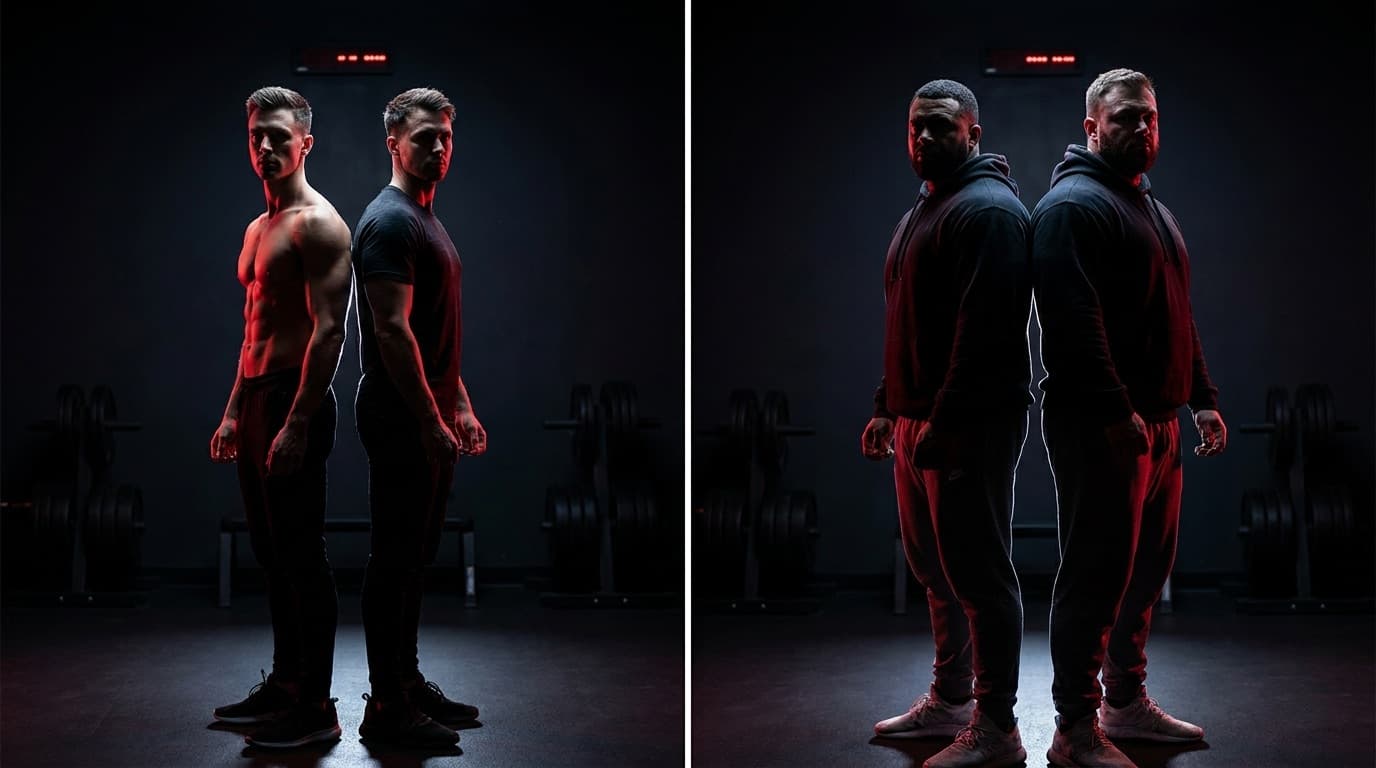
"Should I cut or bulk first?" is the question I get most from new clients — usually from someone who has been doing both at once for a year and getting neither. After 18 years of coaching and stepping on stage as an IFBB Pro, here's the honest framework I use to decide.
Key takeaways:
- Cut first if you're above roughly 18–20% body fat (men) or 28–30% (women).
- Bulk first if you're lean but under-muscled — most beginners gain muscle faster than they think.
- A cut should run 8–16 weeks; a lean bulk 4–8 months. Mini cycles waste time.
- The deciding number is your body fat percentage, not your weight.
- Either way, you need a target: get yours from the macro calculator.
What's the difference between cutting and bulking?
Cutting means eating in a calorie deficit to lose fat while keeping muscle. Bulking means eating in a calorie surplus to build muscle while keeping fat gain low. They're opposite energy states — which is why trying to do both at once usually delivers neither.
Your body builds muscle best with extra energy available, and burns fat only when energy is short. Beginners and people returning after a layoff can do both for a few months (recomposition), but for everyone else, picking a lane is what makes progress visible.
How do you decide which one to do first?
Look at your body fat percentage, not the mirror on a bad day. As a rule of thumb from my coaching practice:
| Your situation | Start with | Why | | --- | --- | --- | | Over ~18–20% body fat (men) / ~28–30% (women) | Cut | A surplus on top of high body fat adds mostly fat, and insulin sensitivity tends to be worse | | Lean (10–15% / 18–24%) but small | Bulk | You have room to grow and a surplus will be used well | | New to lifting (first 6–12 months) | Lean bulk or recomp | Newbie gains let you build muscle even without a big surplus | | Not sure where you are | Measure first | Estimate it in 2 minutes with the body fat calculator |
The reason coaches start most overweight clients with a cut isn't aesthetics — it's physiology. Research shows that resistance training plus a moderate deficit preserves lean mass while fat drops (Murphy & Koehler, 2022 meta-analysis). You lose the fat, keep the muscle, and then build from a leaner base where a surplus does more good.
How long should a cut last?
8 to 16 weeks is the productive window for most people. Long enough to lose 4–8 kg (9–18 lb) of mostly fat at a sensible rate of 0.5–1% of bodyweight per week — short enough that hunger, fatigue and muscle-loss risk don't pile up.
Past roughly 16 weeks, adherence drops and the metabolic adaptation gets louder. If you have a lot of fat to lose, cut in blocks: 12–16 weeks dieting, 4 weeks at maintenance, repeat. My 3-month transformation program is built around exactly this window because it's where clients see dramatic change without burning out.
How long should a bulk last?
4 to 8 months minimum. Muscle is slow tissue — a realistic rate is 0.2–0.5 kg (0.5–1 lb) per month of actual muscle for an intermediate lifter. Bulk for only six weeks and you've built almost nothing; you've mostly just filled glycogen.
Keep the surplus moderate: +10–15% over maintenance, or about 200–400 extra calories. Bigger surpluses don't build muscle faster — protein synthesis has a ceiling — they just add fat you'll have to cut later.
The bulk that works is the boring one: small surplus, heavy training, months of patience.
What should your macros look like in each phase?
The anchors stay the same in both phases; only calories move:
- Protein: 1.6–2.2 g per kg of bodyweight — at the top of the range when cutting, since protein is what protects muscle in a deficit.
- Fat: around 0.8 g per kg — enough for hormones.
- Carbs: everything that's left — they fuel your training, so don't crush them on a bulk.
You don't have to do this math by hand — the calorie and macro calculator gives you targets for a deficit, maintenance or surplus based on your stats.
The mistake that ruins both: yo-yo cycling
The most common pattern I see is two weeks of "bulking" (eating everything), panic, two weeks of "cutting" (eating nothing), repeat. Twelve months later: same body. Phases need time to work. Commit to one goal for a minimum of 8 weeks before you evaluate, and judge progress by weekly averages — weight, photos, waist measurement — not by a single morning on the scale.
Frequently asked questions
Can I build muscle and lose fat at the same time?
Yes, if you're a beginner, returning from a long break, or carrying high body fat — research calls it body recomposition. For trained, lean people it becomes very slow. Picking a dedicated phase is the faster route for almost everyone past the first year.
Should I bulk in winter and cut in summer?
It's a convenient schedule, not a rule. Seasons don't change physiology. What matters is giving the bulk enough months to build real tissue and the cut a defined end date so it doesn't drag forever.
Will I lose my muscle when I cut?
Not if you do three things: keep protein at 1.8–2.2 g/kg, keep lifting heavy (don't switch to light "toning" work), and keep the deficit moderate. Muscle loss in a diet comes from crash deficits and abandoned training, not from cutting itself.
What body fat percentage should I cut down to?
For most men, ending a cut around 10–13% and for most women around 18–22% is sustainable and looks athletic. Stage-lean (sub-6%) is a short-term peak for competitors, not a place to live.
Still not sure which phase fits where you are right now? That's literally my job — apply for coaching and I'll assess your starting point and build the plan, the phases and the numbers around you.
This article is general information, not medical advice. Check with your physician before starting a new diet or training program.